
Conference Themes
16th International Traffic and Transportation Conference on “Advances in Mobility, Energy, Health, and Infrastructure,” brings together researchers, academics, engineers, policymakers, and industry professionals to exchange scientific knowledge, present innovative research, and discuss emerging challenges and solutions in transportation and traffic.
Scientific papers are invited under the following four main themes.
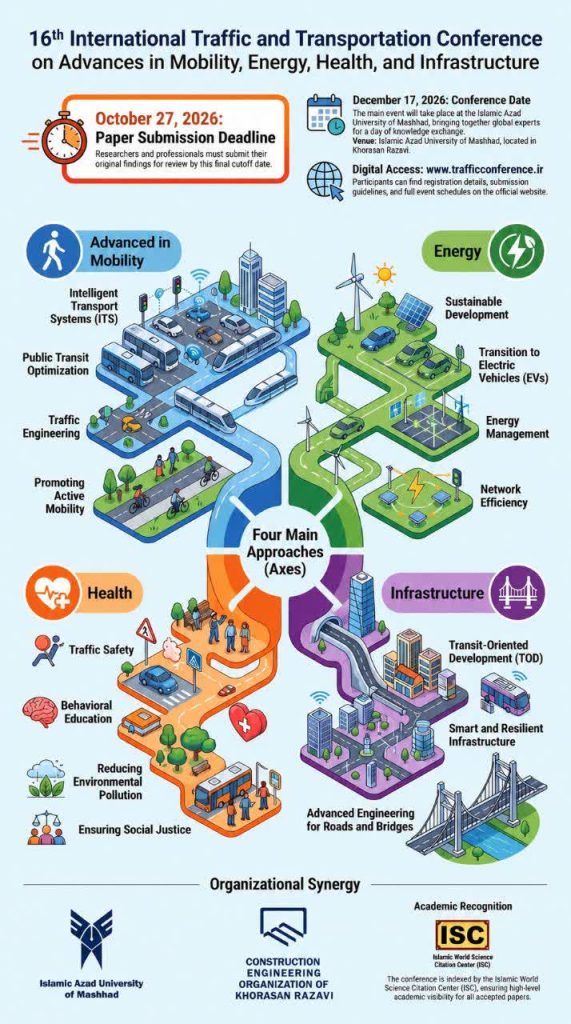
Theme 1: Mobility
This theme focuses on the planning, management, operation, and development of transportation systems and includes the following topics:
- Intelligent Transportation Systems (ITS)
- Public Transportation
- Active and Non-Motorized Transportation
- Traffic Engineering and Safety
- Logistics, Freight Transportation, and Supply Chain
Intelligent Transportation Systems (ITS)
Application of artificial intelligence, data analytics, the Internet of Things (IoT), and decision support systems for transportation planning, traffic management, and intelligent mobility.
Public Transportation
Planning, design, operation, and optimization of public transport networks, including bus systems, metro, and urban rail transit.
Active and Non-Motorized Transportation
Walking, cycling, and the development of sustainable mobility infrastructure that encourages active transportation.
Traffic Engineering and Safety
Traffic modeling and simulation, travel demand management, intersection optimization, traffic operations, and transportation safety improvement.
Logistics, Freight Transportation, and Supply Chain
Planning, management, and optimization of freight movement and logistics systems at urban and regional scales.
Theme 2: Energy
This theme explores the role of energy efficiency and sustainable development in transportation systems, including:
- Transportation and Sustainable Development
- Renewable Energy and Electric Vehicles
- Energy Economics and Transportation
- Intelligent Transportation System Management
Transportation and Sustainable Development
Low-carbon mobility, emission reduction, decarbonization strategies, and sustainable transportation systems.
Renewable Energy and Electric Vehicles
Electric vehicle technologies, charging infrastructure, energy management, and innovative solutions for sustainable transportation fleets.
Energy Economics and Transportation
Economic evaluation of transportation projects, energy consumption management, and investment in energy-efficient transportation technologies.
Intelligent Transportation System Management
Smart strategies for improving energy efficiency and optimizing the performance of urban and intercity transportation systems.
Theme 3: Health
This theme addresses the relationship between transportation, safety, public health, and quality of urban life through the following topics:
- Traffic Safety and Crash Reduction
- Traffic Education, Culture, and User Behavior
- Transportation Policy, Regulations, and Governance
- Transportation, Environment, and Public Health
- Social Equity and Accessibility
Traffic Safety and Crash Reduction
Crash analysis, risk assessment, and the design of safer transportation infrastructure and road networks.
Traffic Education, Culture, and User Behavior
Traffic safety education, public awareness, and strategies for promoting responsible and safe travel behavior.
Transportation Policy, Regulations, and Governance
Transportation policy development, integrated management, institutional frameworks, and regulatory systems.
Transportation, Environment, and Public Health
Air and noise pollution reduction, urban environmental quality, and the impacts of transportation on public health.
Social Equity and Accessibility
Equitable access to transportation services for all members of society, particularly older adults, children, and persons with disabilities.
Theme 4: Infrastructure
This theme focuses on the planning, design, development, operation, and maintenance of transportation infrastructure, including:
- Transportation Infrastructure Planning and Development
- Architecture, Urban Planning, and Transit-Oriented Development
- Roads, Bridges, Tunnels, and Pavements
- Smart and Resilient Infrastructure
- Innovative Construction and Maintenance Technologies
Transportation Infrastructure Planning and Development
Integrated transportation and land-use planning, railway networks, passenger terminals, freight terminals, and logistics hubs.
Architecture, Urban Planning, and Transit-Oriented Development
Urban design, Transit-Oriented Development (TOD), green infrastructure, the relationship between land use and transportation, traffic impact assessment of land developments, accessibility, and parking planning.
Roads, Bridges, Tunnels, and Pavements
Design, construction, maintenance, performance evaluation, and asset management of transportation infrastructure.
Smart and Resilient Infrastructure
Application of advanced technologies, smart monitoring systems, digital twins, and resilience enhancement against natural and human-induced hazards.
Innovative Construction and Maintenance Technologies
Advanced construction materials, innovative implementation methods, and lifecycle management of transportation infrastructure.
Selecting the Appropriate Theme
If your research is relevant to more than one conference theme, you are encouraged to submit your paper under the theme that best reflects its primary objective. When necessary, the Scientific Committee may review the submission and assign it to the most appropriate scientific theme.
Paper Submission
Researchers, faculty members, students, engineers, managers, and transportation professionals are invited to submit their papers after completing the conference registration process and obtaining a Registration Code. Papers may then be uploaded through the conference submission system.
Scientific Program Beyond Paper Presentations
In addition to paper presentations, the conference will feature training workshops, technical sessions, scientific panel discussions, specialized exhibitions, and technical visits. These activities provide valuable opportunities for knowledge exchange, professional networking, and collaboration among researchers, practitioners, and industry experts.